
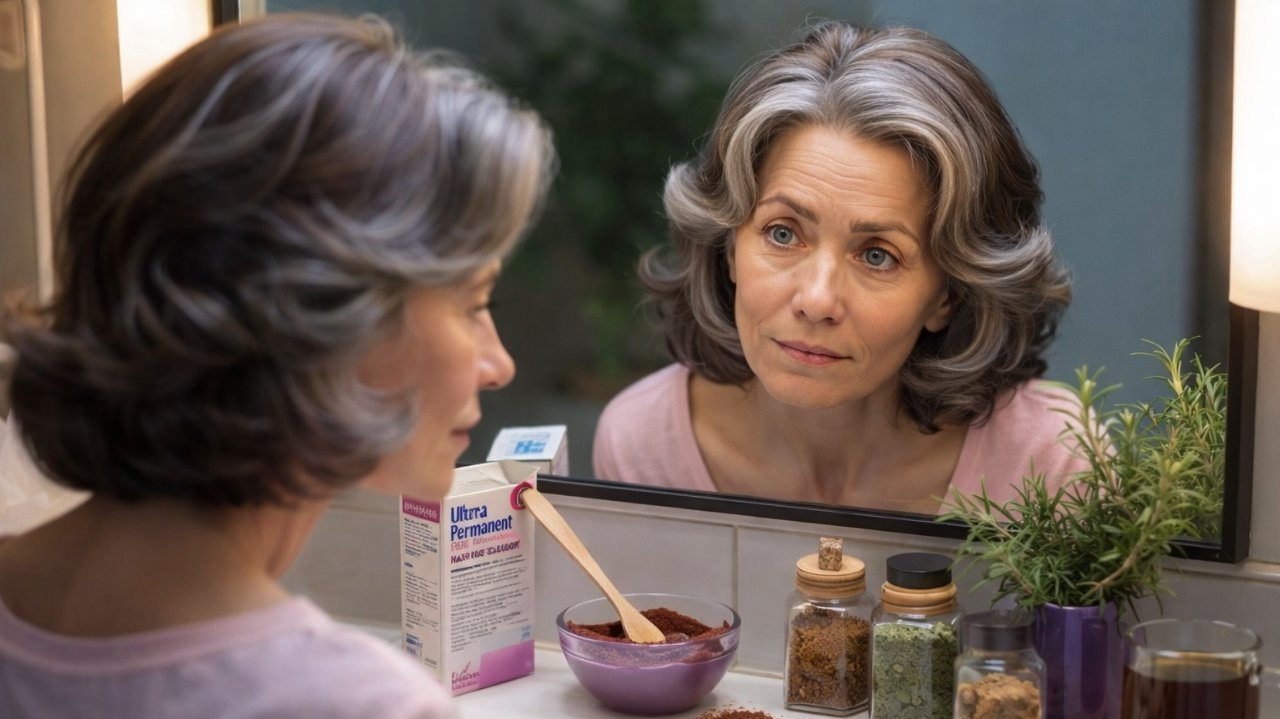
A slow rebellion against the dye aisle
Walk through any beauty aisle and you can sense it — a sharp trace of chemicals mixed with glossy promises of instant youth. For decades, the rhythm never changed. Pick a shade. Cover the grey. Repeat every few weeks. Quiet, routine, unquestioned. Now, alongside those familiar boxes, sit soft packets of herbal powders and plant-based color kits whispering different words: no ammonia, no PPD, no harshness. The language feels gentler, almost like an apology to scalps that have endured years of burning, itching, and staining.
Dermatologists are noticing the shift. Interest in natural grey hair solutions has risen sharply in recent years, driven not by trends alone but by fatigue — tired scalps, brittle hair, endless upkeep. Across social platforms, women are sharing their “silver journeys,” not as surrender, but as a conscious, almost peaceful choice. Colorists report clients arriving with small packets of powdered leaves, hopeful yet unsure, asking if plants can truly replace chemicals. The answer is often yes — but with patience. This is not instant transformation. It is a slower conversation between hair and time.
The reasons behind this movement are simple, almost universal. Repeated coloring leaves hair dry and fragile. Allergic reactions, especially from PPD-based dyes, have pushed many to search for gentler options. Others are simply exhausted by the cycle — roots appearing, appointments returning, money slipping away. Beneath all this lies a deeper shift: grey is no longer an enemy. It is a tone, a texture, something to soften, blend, and work with rather than erase.
Plants are stepping up where bottles used to rule
At the center of this quiet revolution stands something ancient and unremarkable: henna. Pure, finely ground leaves mixed with warm water or herbal tea. On its own, henna wraps grey strands in warm copper and auburn tones. When paired with indigo, it deepens toward brown, sometimes even dark enough to mimic black depending on the hair beneath. The process is slower, messier, almost ritual-like — paste, towels, waiting. Not quick, but strangely grounding.
Beyond henna, gentler methods continue to find their place. Coffee and black tea rinses lend a soft shadow to lighter greys, adding shine rather than full coverage. Sage and rosemary infusions, used consistently, deepen cool tones gradually, especially on hair that still carries some pigment. Modern versions appear in spray bottles as “grey blending mists,” designed not to hide silver but to soften contrast. They do not erase grey — they soften the transition, making regrowth less abrupt, less urgent.
Unlike chemical dyes that penetrate deeply, plant-based color works differently. It coats the hair, building translucent layers over time. The result often appears softer, more dimensional, less uniform. The trade-off is precision — no two heads absorb plants identically. Results evolve slowly, sometimes unpredictably. This is where patience becomes part of the process, and where perfection begins to loosen its grip.
How to shift from chemical dyes to natural grey helpers
The transition rarely begins with a brush or bowl. It begins with time. Experts often suggest stretching the gap between dye sessions — from three weeks to four, then five — allowing natural regrowth to appear. During this period, tinted conditioners, root powders, or plant glosses can soften the line between old color and new growth. Once a few centimeters of natural hair return, herbal color has something authentic to build upon. Without that base, results can feel uneven, uncertain.
Many expect immediate transformation from their first natural application. It rarely happens. Early sessions may look subtle, even patchy, especially where grey is concentrated. Specialists often recommend a gradual approach — several sessions spaced weeks apart, allowing tone and depth to build slowly. Life rarely allows perfect consistency, yet those who persist often notice something unexpected: hair begins to feel fuller, softer, more personal — less like a disguise, more like itself.
“Traditional dyes offered uniformity. Plants offer character. Grey doesn’t vanish — it shifts, reflects, becomes part of the story rather than something to erase.”
- Do a strand test first — Always test herbal blends on a small hidden section before full application.
- Choose quality over shortcuts — Pure plant powders without additives give safer, more predictable results.
- Hydrate consistently — Oils, masks, and gentle care keep natural tones reflective and healthy.
- Accept the “in-between” phase — Hair may look neither fully grey nor fully colored for a while.
- Seek experienced guidance — A professional familiar with herbal coloring can smooth the transition.
● Top 6 Yoga Moves for a Stronger Spine
Grateful for Relief: 5 Gentle Yoga Poses That Calm Neck Pain Naturally
11-Minute Yoga Routine to Increase Core Strength and Flexibility
15-Minute Yoga for Beginners You Can Do Anytime — No Experience Needed
At-Home Bodyweight Moves That Sculpt Stronger Legs Without Weights or Gym Memberships
Grey hair, new rules
What is changing is not just the method of coloring, but the relationship with aging itself. Those exploring natural grey often describe a quiet mix of vulnerability and relief. The first glimpse of soft silver beside a warm herbal tone feels different — less like loss, more like acceptance. Hair stops being a problem to fix and becomes something to shape gradually, thoughtfully. The harsh line between dye and root begins to fade, not only in color, but in meaning.
This path is not for everyone. Some will continue with traditional dyes, comfortable with their certainty. Others will embrace full silver, untouched and unapologetic. Between these choices lies a gentler middle — herbal blends, soft glosses, subtle shifts that respect both past and present. It is a slower rhythm, guided by patience rather than urgency. Conversations change too — from covering grey to understanding it.
If curiosity arises, there is no need for dramatic declarations. Sometimes it begins quietly — delaying the next coloring session, rinsing hair with tea, watching how silver catches the morning light. You may return to familiar dyes, or you may discover that a soft blend of grey and warmth feels unexpectedly true. The choice becomes less about hiding time, and more about shaping how you carry it.
Key Points
| Key point | Detail | Value for the reader |
|---|---|---|
| Natural grey solutions build gradually | Herbal colors layer over time rather than delivering instant uniform coverage | Helps set realistic expectations |
| Transition requires patience | Extending dye cycles and softening regrowth makes the shift smoother | Reduces visible contrast and stress |
| Quality and guidance matter | Pure plant products and informed advice prevent uneven results | Improves safety and outcome |